
Transfer Access Network (TAN)
One referral connects patients to every facility – faster.
Instead of relying on fragmented phone calls, repeated follow-ups, and limited visibility, TAN Command Center provides hospitals with a faster, clearer way to send, route, and track transfer requests across facilities.
When transfers are delayed or misrouted, patient care, flow, and costs suffer. Research shows delays increase length of stay and costs. TanCC.health moves patients faster to the right service, reducing wasted outreach and supporting efficiency.
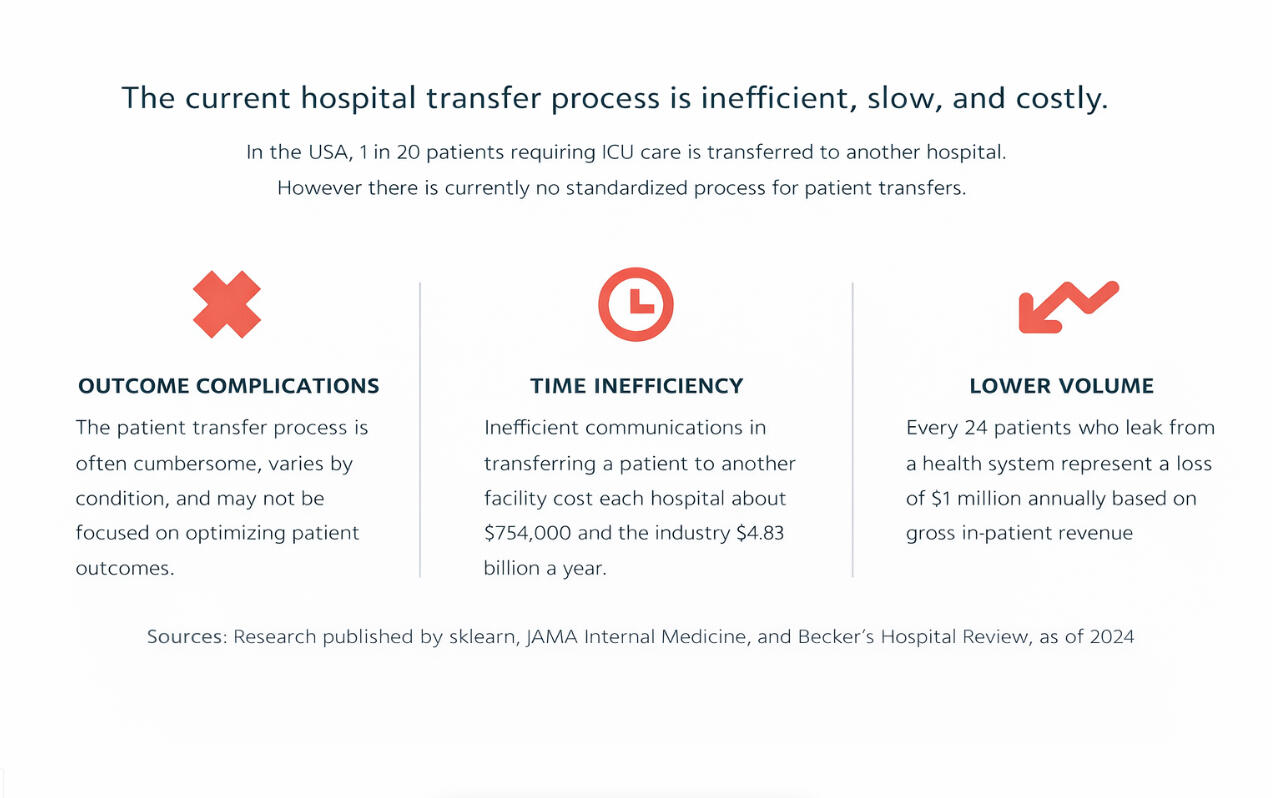
Current State: Fragmented & Reactive
Transfer Process still depend on manual workflows.
Lack Standardized Process — Transfer requests often depend on disconnected calls, updates, and handoffs between multiple teams and facilities.
Limited visibility — It can be difficult to know where a transfer stands, who is reviewing it, and what the next step should be.
Operational burden — Case managers, nursing supervisors, and transfer teams spend valuable time managing a process that should be faster and more transparent.
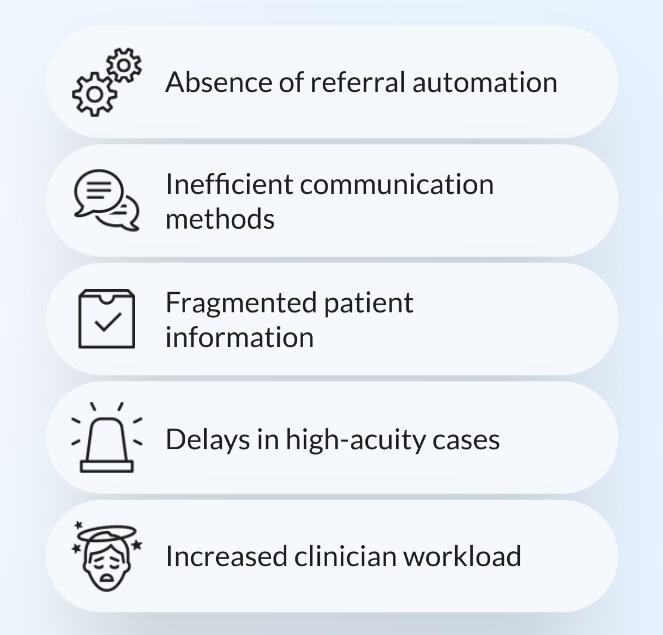
Manual Coordination — Repeated calls, fragmented updates slow the process.
Poor Matching — Facilities may send cases to hospitals without the needed service.Too often, referring facilities spend valuable time calling hospitals that do not offer the specialty, service, or level of care the patient actually needs. At the same time, receiving hospitals waste time reviewing referrals for services they do not provide or patients they cannot appropriately accept.
Without a platform, nurses may spend hours calling hospitals that can’t help. TanCC.health allows one digital request, matching with the right service quickly.Instead of hours calling, one TanCC request can yield acceptance in minutes.
The Solution
Submit once. Route intelligently. Track end-to-end.
Submit once => One standardized referral
Steamline Referral Routing
Route instantly => Match to the right service faster
Minimize Waste
Track status => Improves Efficiency
See where the transfer stands in real time.
Reduce friction => Seamless Transfer Experience
Cut down repeated calls, follow-up, and uncertainty.
Reduce delays & elevate the standard of care
The Operating Principles

1. Start with one clear intake
Standardize every transfer request from the beginning.2. Submit once
Avoid restarting the process with every additional call.3. Route intelligently
Connect patients to the right level of care faster.4. Make status visible
Give teams clear transfer visibility from start to finish.5. Carry urgency forward
Protect speed and escalation for critical cases.
6. Coordinate in one workflow
Replace fragmented handoffs with one shared process.7. Create value on both sides
Support both referring and receiving hospitals.8. Reduce friction. Protect capacity
Improve flow, efficiency, and access to care.9. Measure what matters
Track the data that improves performance.10. Keep the patient at the center
Move patients to the right care with less delay.
Strategic Transfer Intelligence (STI)
TanCC.health goes beyond workflow. It identifies service fit, payer type, strategic case value, and next best actions—helping hospitals reduce delays, improve flow, and align with service-line goals.
Two-Sided Added Value
For referring hospitalsFaster placement to higher-level careLess manual follow-upBetter support for ER & inpatient flowLess burden on case management and nursing teams
For receiving hospitalsFewer irrelevant referralsBetter referral qualityFaster response to high-value casesBetter coordination without more manual work
Pilot opportunity
Start with a focused pilot.
We’re seeking hospital partners for a focused pilot to prove faster coordination, better matching, and operational efficiency improvements—without a large rollout on day one.The goal is simple: prove that a better transfer workflow can improve speed, visibility, and coordination without forcing a large rollout on day one.
Meet the founders
Built by healthcare operators who understand transfer coordination from both the operational and clinical side.
Johnny Tan, MPH
Co-Founder
Healthcare project leader focused on improving transfer coordination, patient flow, and operational efficiency.Randell Smith, RN, MHA
Co-Founder
Nurse leader with expertise in clinical operations, care coordination, and hospital workflows.Pushkar Phatak, B.Tech, MSIS, MSF
CTO / CPO
Fintech and healthcare technology executive focused on payments infrastructure, digital assets, AI, and health system vendor management.